
How to Choose a Water Purifier (India): RO vs UV vs UF, TDS Basics, and What Actually Matters
If you’ve ever had days when the tap water smells like chlorine, tastes “salty”, or leaves white stains on buckets and kettles, you already know why choosing a purifier in India is confusing. The problem isn’t lack of options—it’s that different homes get very different water. That’s why How to Choose a Water Purifier isn’t a “best brand” question. It’s a your water source + your TDS + your usage question. Once you get those three right, the right purifier type becomes obvious, and you’ll avoid the two classic mistakes: buying RO when you don’t need it, or skipping RO when you absolutely do.
Quick Answer (For Busy Buyers)
Test your water TDS first (cheap TDS meters are widely available), then match the purifier to your source:
- Municipal water + low TDS: UV + UF (with activated carbon) is often enough.
- Borewell/tanker/mixed supply + high TDS/hard water: RO (ideally RO + UV/UF) is usually the safer pick.
- Don’t decide by “stages” alone: maintenance cost and service availability matter as much as technology.
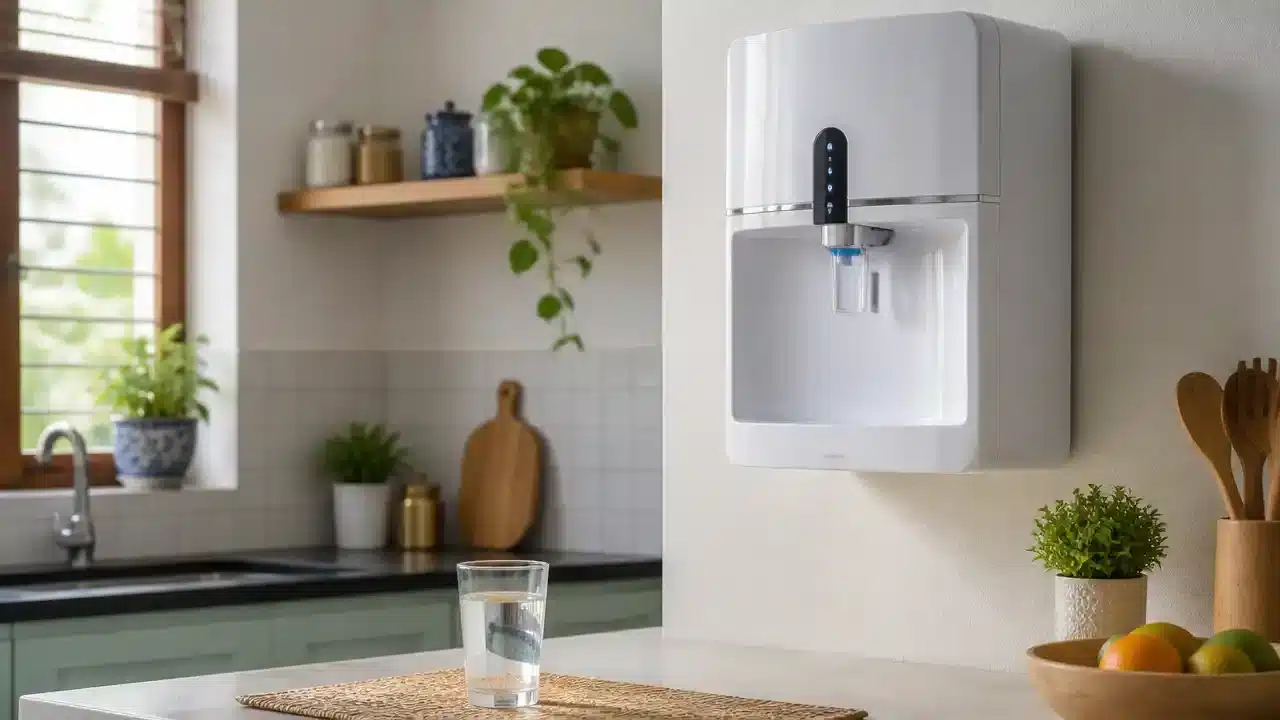
Step 1: Identify Your Water Source (This Changes Everything)
Before features, apps, “copper/alkaline” claims, and big storage tanks—figure out what kind of water you actually receive at home. In Indian cities, even neighbouring buildings can have different water quality.
Municipal (corporation) supply
- Often has chlorine (smell/taste issues), and sometimes sediment after pipeline work or monsoon.
- TDS is commonly on the lower side compared to borewell water, but can vary.
- Risk: microbial contamination can still happen if pipelines are old or water storage tanks aren’t cleaned.
Borewell water
- More likely to be hard water with higher dissolved solids (high TDS).
- Can cause scaling on taps, geysers, kettles; water may taste “mineral/metallic/salty”.
- Usually needs RO-based purification for dissolved impurities reduction.
Tanker water
- Quality can be inconsistent across loads.
- Often a mixed bag: sediment + microbial risk + sometimes higher TDS.
- Safer approach is typically RO + UV/UF if quality is uncertain.
Mixed source (municipal + borewell, or switching seasonally)
This is extremely common in apartments and independent houses. Mixed-source homes are where people suffer most after buying the “wrong” purifier. If your source changes, choose a purifier that can handle your worst-case water days.
Step 2: Do a Simple TDS Check (The 30-Second Test That Saves Money)
A TDS meter is one of the most practical tools for a water purifier buying guide. It won’t tell you everything (like germs), but it’s excellent for deciding whether RO is needed for dissolved impurities.
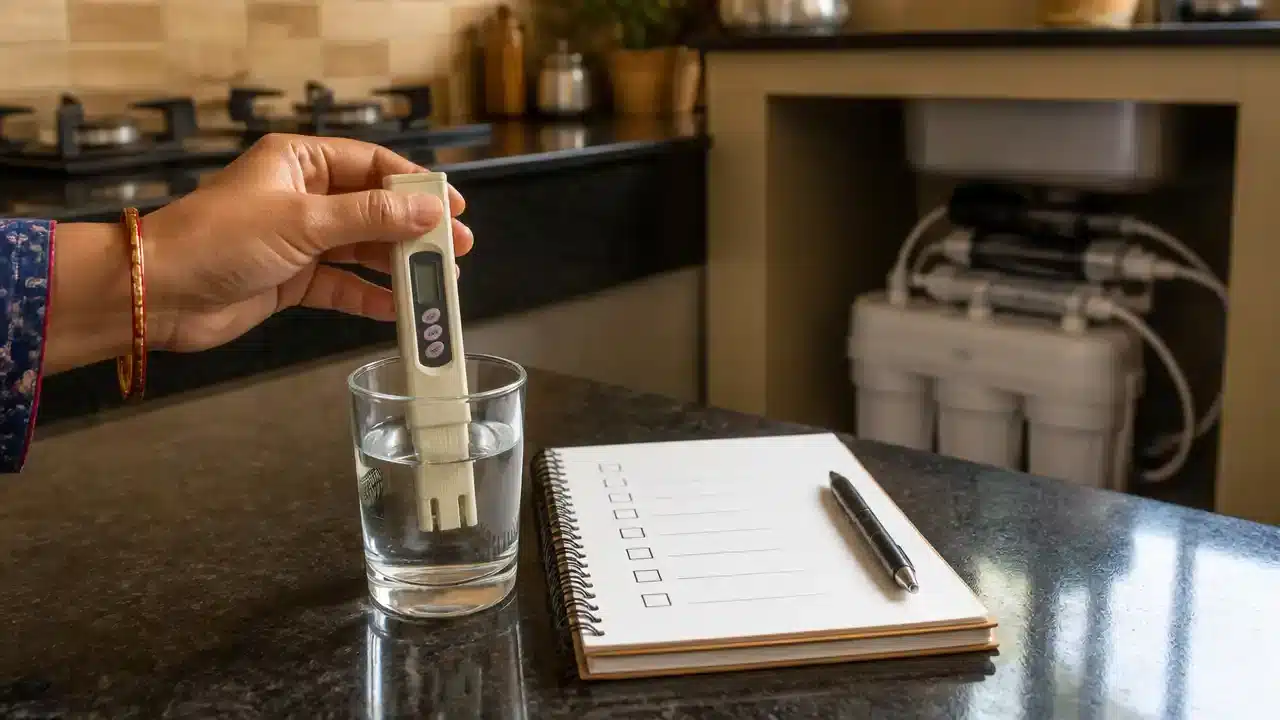
How to check water TDS at home (quick method)
- Take a glass of water from the same point you’ll connect the purifier (kitchen tap or inlet line).
- Switch on the TDS meter, dip the probe, wait for the reading to stabilise.
- Repeat once more at a different time (morning vs evening) if your supply changes.
Practical TDS-to-purifier guidance (real-world, India-friendly)
Exact thresholds can vary, but these ranges are useful for shortlisting:
- Low TDS (typically under ~300 ppm): RO may be unnecessary in many municipal setups. Consider UV + UF + carbon for taste, chlorine, and microbial protection.
- Mid TDS (around ~300–500 ppm): This is the grey zone. If the source is municipal and taste is fine, UV/UF may still work. If it’s borewell/mixed supply or you see scaling, consider RO with a TDS controller/mineraliser.
- High TDS (often above ~500 ppm): Common with borewell/tanker. Shortlist RO-based systems (ideally RO + UV/UF) and pay attention to maintenance and reject-water handling.
Important: TDS is not a “purity score”. Lower TDS doesn’t automatically mean safer water, and higher TDS doesn’t automatically mean unsafe. TDS is mainly for dissolved solids decision-making. Microbes need UV/UF/boiling-level control, not a TDS meter.
Step 3: Understand RO vs UV vs UF (So You Don’t Buy the Wrong Tech)
Most confusion comes from marketing around “stages”. Instead, focus on what each technology is good at.
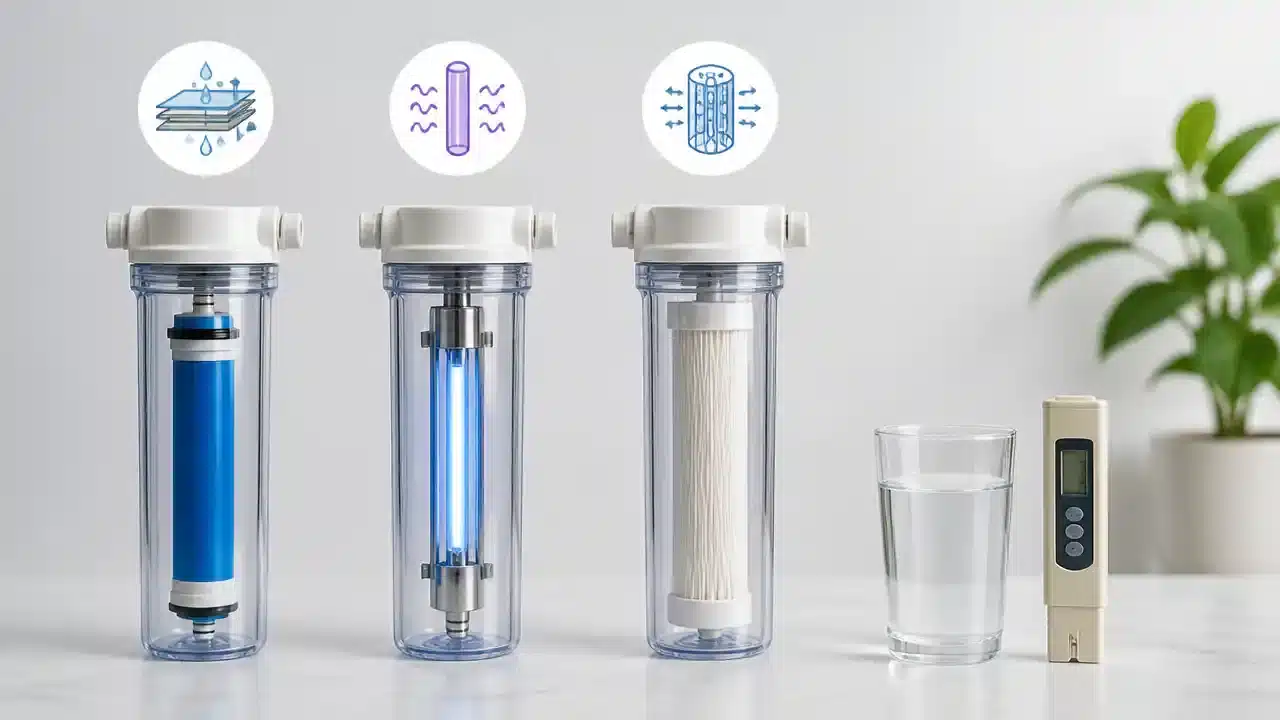
RO (Reverse Osmosis)
Best when: you have borewell/tanker/mixed water, hard water, high TDS, or you suspect dissolved contamination (like heavy metals/fluoride risk in some regions).
- Strength: Reduces dissolved solids significantly and offers broad protection for many India-style water issues.
- Trade-off: Creates reject water (wastage). Also needs electricity and regular maintenance.
- Tip: Prefer RO systems with a TDS controller/mineraliser so the output doesn’t taste flat—especially if your input TDS isn’t extremely high.
UV (Ultraviolet)
Best when: you have relatively low-TDS water but want protection against microbial contamination (bacteria/viruses).
- Strength: Great at neutralising microbes.
- Limitation: Does not reduce TDS or hardness; won’t fix “salty” taste from dissolved solids.
UF (Ultrafiltration)
Best when: you want an extra barrier for turbidity/particles and some microbial reduction, often paired with UV.
- Strength: Useful for low-TDS water, sometimes available in non-electric designs.
- Limitation: Does not reduce TDS; not the solution for hard water scaling issues.
Activated carbon (taste and chlorine control)
Carbon filters are underrated. For many municipal-water homes, carbon is what makes the water taste “normal” again by reducing chlorine smell/odour and improving taste.
RO + UV + UF: when “combo” actually makes sense
If your water quality changes with seasons, or you rely on tanker/mixed supply, a combo purifier is often the most practical because it covers both dissolved and microbial risks. Just be ready for higher running cost and regular servicing.
How to Choose a Water Purifier for Indian Home: A Simple Decision Tree
- If your supply is mostly municipal and TDS is low-to-mid with no scaling: shortlist UV + UF + carbon.
- If you see heavy scaling on taps/kettle/geyser, or TDS is high: shortlist RO (preferably with TDS controller/mineraliser).
- If your water source changes (municipal sometimes, borewell/tanker sometimes): shortlist RO + UV/UF.
- If power cuts are frequent: ensure you have adequate storage and check whether the purifier can dispense stored water when power is off (this varies by design).
Key Buying Factors Most People Ignore (But Pay For Later)
1) Maintenance cost in India (filters + AMC)
Purchase price is the entry fee. The real cost is filter replacements and service. Many guides quote annual maintenance commonly around ₹2,000–₹5,000 depending on model, water quality, and usage. RO systems usually sit on the higher end because pre-filters, membrane health, and service intervals matter more.
- Hard water = faster filter choking: Sediment and scaling can reduce filter life.
- Service access matters: Even the best purifier becomes useless if cartridges or service techs aren’t available in your area.
- Ask this before buying: What’s included in warranty? How many free visits? What is covered vs excluded?
2) Storage tank size (especially during power cuts)
Storage isn’t just convenience—it’s resilience. In many homes, mornings are peak demand: filling bottles, cooking, kids’ school tiffins, and tea/coffee. If your area has power cuts, storage helps you ride through them.
- 1–2 people: Smaller tanks can work if water supply is stable.
- 3–5 people: Prefer a comfortable storage capacity and decent flow rate.
- Joint family: Storage and faster purification become more important than fancy add-ons.
3) Purification speed (litres/hour) vs real usage
Purification rate matters more when you have low storage or a big family. A purifier that can’t keep up tends to run for long hours, increasing wear and service frequency.
4) Water wastage (RO reject water) and how to manage it
RO purifiers reject some water while removing dissolved solids. In water-scarce areas, this is a serious consideration.
- Plan a reject-water line to a bucket/drain point for floor mopping, toilet cleaning, or balcony washing.
- Keep expectations realistic: “zero wastage RO” claims often depend on specific conditions and may involve trade-offs.
5) Space and installation (wall, counter, under-sink)
- Wall-mount: Most common, easy access, saves counter space.
- Counter-top: Good for rentals or when drilling is not allowed, but needs counter space.
- Under-sink: Clean look and saves space, but can be inconvenient for filter access and may cost more to install.
6) Service network and spare parts
For Indian buyers, this is as important as RO vs UV vs UF. Choose brands/models that have reliable service coverage in your city (and ideally nearby towns if you move). Check how quickly filters can be replaced and whether standard consumables are readily available.
TDS Level for Water Purifier: Practical Shortlisting Table
| TDS range (approx.) | Common Indian scenario | What usually works | What to watch |
|---|---|---|---|
| Under ~300 ppm | Many municipal supplies | UV + UF + activated carbon | Don’t buy RO just because it has more “stages” |
| ~300–500 ppm | Some municipal edges, mixed supply, mild hard water | UV/UF if taste is fine; RO with TDS control if scaling/taste issues | Decide based on source stability and scaling signs |
| Above ~500 ppm | Borewell/tanker in many areas | RO (often RO + UV/UF) | Reject water planning, higher maintenance cost |
Common Feature Traps (What Sounds Great, But Shouldn’t Decide Your Purchase)
“12-stage / 14-stage” marketing
Stages don’t automatically equal safety. Many “stages” are just multiple carbon or polishing filters. What matters is whether the purifier has the right core technology for your source (RO vs UV/UF), and whether you can maintain it.
Copper/alkaline/mineral claims
These can be fine as add-ons, but treat them as secondary. First decide if you need RO at all. If you do need RO, a mineraliser/TDS controller can help with taste. But don’t buy a “copper” purifier to solve hard water—hard water is a dissolved solids problem, and that’s RO territory.
“Smart” app features
A filter-change reminder is useful, but it won’t compensate for poor service or unavailable spare parts.
What to Ask (or Verify) Before You Finalise Any Model
- Which purification tech is included? (RO / UV / UF / carbon)
- Is it suitable for my water source? (municipal vs borewell vs tanker vs mixed)
- What’s the expected annual maintenance? (filters + service visits; ask for a realistic range)
- How often are filters replaced? (depends on water quality; get the schedule and typical costs)
- What happens during power cuts? (storage dispensing and recovery time)
- Reject water handling: where will the pipe go, and can your kitchen layout support it?
- Service coverage: do they have a technician route in your locality? What’s the typical turnaround time?
Comparison Table: Which Purifier Type Is Best for Whom?
| Purifier type | Best for | Biggest advantage | Main drawback | Buyer note |
|---|---|---|---|---|
| UV + UF + Carbon | Municipal water with low TDS | Good taste + microbial layer without RO overkill | Won’t solve hard water / high TDS | Excellent if your TDS is low and supply is stable |
| RO (with Carbon) | High TDS, hard water, borewell | Reduces dissolved solids | Reject water + higher maintenance | Prefer a TDS controller/mineraliser for balanced taste |
| RO + UV + UF | Mixed supply, tanker dependence, uncertain water | Broad protection for Indian conditions | Higher running cost | Worth it if your water quality changes often |
| UF (non-RO) | Low TDS areas, basic filtration needs | Can be simpler and sometimes less electricity-dependent | Doesn’t reduce TDS | Good as a basic solution, not for hard water |
My Practical Recommendation (Shortlisting Method That Works)
- First shortlist by water: source + TDS + scaling signs.
- Then shortlist by living reality: family size, power cuts, kitchen space, and reject water handling.
- Finally shortlist by ownership comfort: service network, filter availability, and expected annual maintenance.
If you do just this, you’ll end up with 2–3 purifier types/models that genuinely fit your home, instead of buying the most advertised one and regretting it during the first filter change.
Conversion Nudge (No Pressure, Just Smart Buying)
If you’re planning to buy soon, do two things today: check your TDS and write down your water source pattern (municipal only, borewell only, or mixed). With those two inputs, you can confidently decide between RO vs UV vs UF and compare models on maintenance and service—not hype.
FAQs
Do I need RO for municipal water?
Not always. If your municipal water has low TDS and doesn’t cause scaling, a UV + UF + activated carbon purifier is often sufficient. Consider RO mainly when TDS is high, taste is salty/metallic, or you have mixed/borewell supply.
What TDS level needs an RO purifier?
As a practical rule, if your TDS is consistently in the high range (often above ~500 ppm), RO becomes a strong requirement for reducing dissolved solids. In the mid range (~300–500 ppm), decide based on source stability and scaling/taste issues.
RO vs UV vs UF: which is better for Indian homes?
There’s no single “better”. RO is better for high-TDS/hard water. UV is better for microbial protection when TDS is low. UF helps with turbidity/particles and often complements UV. Many mixed-source homes do well with RO + UV/UF.
Is RO water safe for daily drinking?
Yes for most households, especially where high TDS/hard water is a reality. If your input TDS is not very high, prefer RO units with a TDS controller/mineraliser to avoid overly “flat” taste and keep the output balanced.
How often should purifier filters be changed?
It depends on input water quality and usage. Homes with hard water or high sediment typically need more frequent changes. The safest approach is to follow the brand’s schedule, watch for flow reduction/taste change, and avoid stretching filters beyond their practical life.
Do I need UV if I already have RO?
RO handles dissolved impurities very well, but many buyers still choose RO + UV (or RO + UV + UF) for added microbial assurance—especially with mixed supply, tanker water, or questionable storage conditions.
Why does my purifier water taste different after installation?
New filters can slightly change taste initially, and RO can make water taste less “mineral” if it reduces TDS significantly. A mineraliser/TDS controller and proper flushing during installation usually improves this. If taste becomes unpleasant later, it can indicate filter exhaustion.
What is the typical water purifier maintenance cost in India?
It varies by technology and water quality, but many Indian buying guides mention annual maintenance often around ₹2,000–₹5,000. RO systems typically cost more to maintain than UV/UF-only systems due to multiple consumables and membrane care.
Conclusion
The smartest way to decide How to Choose a Water Purifier is simple: test TDS, confirm your water source, then pick the technology (RO vs UV vs UF) that matches your reality. After that, focus on things you’ll live with every month—service response, filter availability, storage during power cuts, and realistic maintenance cost. If you want a low-regret purchase, start with a TDS reading today and shortlist accordingly.
Next step: Note your TDS range and water source (municipal/borewell/tanker/mixed), then compare only those purifier types that fit—your wallet and your water will both thank you.